For about a century, Major League Baseball (MLB) had been the professional sports league most synonymous with gambling problems within its ranks. From Babe Ruth’s 1924 letter to the MLB commissioner apologizing for his gambling behavior and Pete Rose’s 1989 ban for betting on games while managing the Cincinnati Reds, to the recent speculation about what really happened with LA Dodgers’ superstar Shohei Ohtani in 2024, the MLB has carried the burden. It now seems that the unfortunate torch has been passed to the National Basketball Association (NBA).
While there have been rumblings of gambling problems on the parquet for years, especially since the federal ban on sports betting was removed in 2018, things ramped up for the NBA when Toronto Raptors’ Jontay Porter was handed down a permanent ban from the league in April of 2024. Investigations revealed that Porter wagered on his own games and was allegedly involved (possibly as a victim) in an organized gambling ring based out of New York. Things have heated up significantly since then. At the start of 2025, it was reported that Miami Heat point guard Terry Rozier was under investigation in connection with a sports betting scandal. As of July (2025) it was announced that Rozier remains under federal investigation:
Before the news of the Heat player’s potential gambling problem had a chance to cool off, it had come to light that Detroit Pistons’ Malik Beasley is also the subject of a federal probe relating to allegations of gambling on NBA games and proposition bets. Compounding Beasley’s woes, is a lawsuit filed by his former marketing agency, demanding the repayment of a $650,000 advance made to the player. Conjecture runs abound about whether or not his financial issues (a symptom of problem gambling) are directly related to his alleged violation of NBA sports betting policy. Then, as July of 2025 came to a close, it was reported that NBA veteran Marcus Morris was arrested at the Fort Lauderdale-Hollywood International Airport on felony fraud charges out of Nevada. Morris’ allegedly owed $265,000 to two Las Vegas casinos after bouncing checks to pay off markers, which he has since repaid. At the very same time (July 30, 2025) news broke that former Washington Wizards point guard Gilbert Arenas was arrested alongside an Israeli crime figure over illegal gambling business allegations. The addition of Morris’ and Arenas’ stories to the growing reports of NBA player gambling problems prompted former Boston Celtics center Kendrick Perkins to recently (August 1, 2025) speak out about his struggles with gambling addiction and the toll it has taken on his mental wellbeing.
If you didn’t think that the NBA had a player gambling problem prior to reading this, where do you stand now?
While some of what is and has been occurring may be chalked up to bad behavior, Perkins’ admission about gambling addiction begs stakeholders to take a deeper look at what’s going on. Research shows that elite athletes (NBA players included) have higher rates of problem gambling (6%), moderate-risk gambling (14%), and low-risk gambling (19%), which far exceed the equivalent rates of the general population. Furthermore, studies confirm that around 35% of elite athletes suffer from anxiety and/or depression, both of which are are comorbid with problem gambling. Anxiety and depression are just two among other mental health disorders that athletes struggle with, that also cooccur with problem gambling (view them all here). Understanding this distinct vulnerability and recognizing a clear issue with NBA player gambling, the league is encouraged to take a timeout prior to the start of the upcoming season and take steps to correct course. Below is an overview of where all stakeholders can start making a difference.
Overview of What the NBA Needs to do to Address its Player Gambling Problem and Become a Positive Example for Other Leagues in the USA
Early Intervention to Onboard Healthier Players
Gambling behavior starts in middle adolescence for millions of Americans, a number of whom are elite student athletes preparing to leave varsity basketball and enter the NCAA with their sights set on the NBA (and WNBA). If left ungoverned, gambling behavior carries over into their collegiate career, where combined academic and athletic pressures mount and compound stress, anxiety, and depression, for which gambling may serve as a coping mechanism. And if this too is unchecked, it may then carry over into the NBA for those who are drafted. What’s happening in the league at the moment is a testament to what may happen next.
There is little question that preventative measures must be taken to keep upcoming generations of NBA players free from the harms of gambling (in all of its forms). Given that high school students have a 100% higher rate of problem gambling than adults in the USA, it’s clear when and where the NBA should invest. In 2018 (the same year the ban was removed on sports betting) the league announced a plan for starting relationships with elite teenagers while they are in high school. To date, these programs provide skills to help varsity players develop both on and off the court, opening an alternate path to the NBA outside of college and a way they could earn a meaningful salary either from NBA teams or as part of the developmental G League. Considering everything that professional leagues now know about problem gambling among their athletes, building a youth gambling awareness program within every high school that the NBA gets involved with should be considered mission critical (here’s how).
Intervention strategies must become more robust at the collegiate level, as young adult athletes are thrust into the spotlight with hopes of making their mark during March Madness. The rise of sports betting in the United States has evolved pressures they innately face in competition, as now they are being harassed by disgruntled sports bettors and targeted by gambling rings for inside information. In a recent statistical analysis from a survey conducted by the NCAA (view here) it was found that Division I men’s basketball players are more than two-times more likely that Division I men’s football players to be leaned on for information that may sway game and player prop wagers in one direction or another. When you consider this, along with the fact that Raptors’ Jontay Porter and Wizards’s Gilbert Arenas were both implicated with illegal gambling rings, it becomes evident that interventions must prepare them to manage the pressures from the sports betting community…and its underworld.
To reiterate, the NBA is advised to make problem gambling education a core principle in any program that seeks to identify and foster talent at both high school and collegiate levels. This will help ensure that newly arriving players in the league are more mindful of their behaviors and emotions, and better prepared to defend against gambling’s full court press.
Leave No Room for Policy Misunderstandings
In multiple instances of league gambling policy violations among professional athletes, players used a lack of policy understanding as a defense. The NBA is encouraged to leave no room for misunderstandings. The “best practices” of any effective organizational training program should be employed, which at the very least must feature the following:
- Mandatory league gambling policy refresher as NBA training camps kick off in late September, about a month before the regular season begins in October.
- Q&A period upon conclusion of gambling policy information session/s to ensure absolute clarity.
- After-session/s written tests to ensure understanding of materials.
- Provision of educational booklets (digital and hardcopy) for players/staff to “take home”.
- Integration of an ongoing online forum for players to ask questions about league gambling policy in real time.
- Immediate follow-up sessions to account for changes and updates to policy
Reassess Relationships with Gambling Platforms
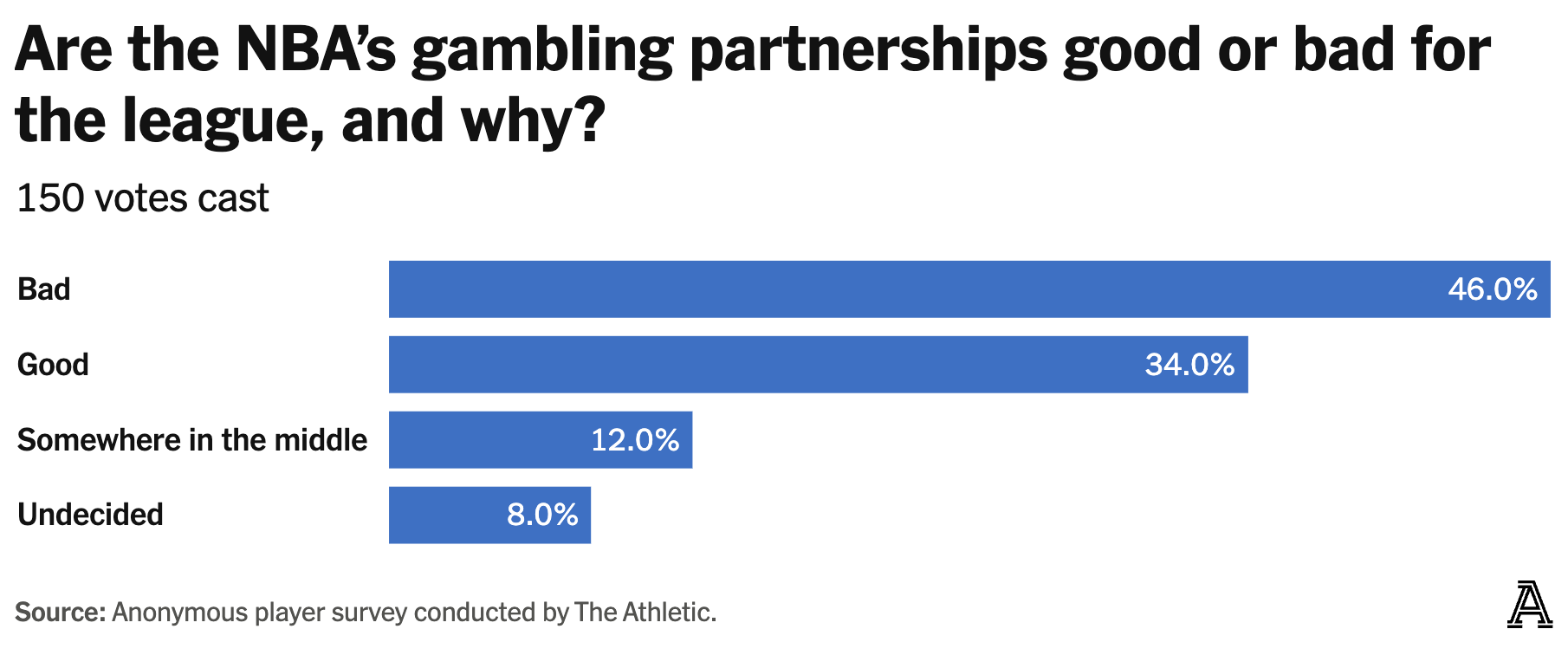
The results that you see above are from the 2025 Anonymous NBA Player Poll conducted by The Athletic. Nearly one-third of the entire league shared their opinions with The Athletic, specifically in regards to whether or not players perceived the NBA’s partnerships with gambling operators to be good or bad for the league. The majority of those surveyed think that it’s a bad idea. The following quote from the survey singles out one of the most problematic aspects of gambling operator partnerships in a league that is currently plagued by player gambling scandals:
“It’s not great when you’re banning players, understandably, for gambling, and then you’re promoting it. It would be like telling us not to do cocaine and then giving the players cocaine in the locker room.” (The Athletic)
It may not be realistic to suggest that the league should sever ties with gambling operators. However, the NBA is encouraged to take a more firm stance with respect to problematic betting products that are known to compromise player integrity and subsequently that of the league. In a direct response to the Jontay Porter gambling scandal from the 2024 season, the NBA and its gambling partners agreed to a deal that removed UNDER prop bets on the lowest paid, most vulnerable players in the league. While it’s a start, many suggest that it’s not enough to mitigate risk. Player props contribute to gambling problems in the NBA via the following:
- Leads to player harassment from disgruntled bettors as they irrationally blame players for losses.
- May compromise player integrity, as it creates temptation to alter performance for financial gain or to get out of their own gambling debt, et cetera.
- Encourages predatory practices against players from organized gambling rings.
As the NBA prepares to renegotiate terms with gambling partners in the future, betting products that create risk to vulnerable players should be reconsidered.
Greater Investment in Player Problem Gambling Support
Moving forward, the NBA must increase investment in player behavioral health to increase focus on both research and support as it pertains to problematic gambling behavior and cooccurring mental health issues. Incoming, active, and retired players should have unlimited and confidential access to counselors who specialize specifically in treating problem gambling and comorbid concerns among the elite athlete population. In doing so, the league will not only avoid a continued public relations nightmare, they will create a healthier environment for its player base to thrive, and will serve as an example for all other professional, collegiate, and amateur leagues in the United States.
Ask About Athletic Programs and Partnerships
CALL +1 (877) 426-4258
OR
Email help@kindbridge.com