There is a misconception held by some members of the general public that behavioral and mental health improvements are not measurable in a quantitative sense. It may be what keeps some from seeking much needed help for issues they may be experiencing, including problem gambling. It may be why each month, hundreds of Americans ask Google “Does gambling treatment work?” when deciding whether or not to engage with a counseling service.
In reality, measurement-based care (MBC) is becoming a standard for monitoring treatment effectiveness, improving client outcomes, and facilitating communication between clients and clinicians. There are a number of measurements that clinicians use to determine positive outcomes. For instance, when treating problem gambling, a clinician seeks to improve scores for mental health issues that cooccur with problematic gambling behavior, which include (but are not exclusive to) depression, anxiety, and stress. Considering this, clinicians will provide clients with a Depression, Anxiety, and Stress Scale-21 (DASS-21), which is a self-report questionnaire used to assess symptoms of each. While we will explore these specific scores and other quantitative data in future editions in this series (“Does Gambling Treatment Work”), today’s measurement focus is on client engagement scores.
In mental health, engagement rates/scores generally refer to how often individuals participate in treatment or services, such as attending therapy sessions or using a digital mental health tool. It can also describe a client’s active involvement, commitment, and emotional connection to the therapeutic process, which involves more than just attendance. It is a strong predictor of recovery and positive outcomes. While it may vary by clinical environment, engagement in counseling services can be understood in dimensions, including behavioral engagement, cognitive engagement, and affective engagement. Behavioral engagement refers to a client’s adherence to treatment, such as following through on session attendance, completing homework, or using digital modules as intended. It also includes the active effort clients make within treatment, such as communicating openly and making real-life changes. Cognitive engagement references a client’s belief in the treatment rationale, perceiving it as appropriate for reaching their goals, and actively using their thinking skills. Meanwhile, affective engagement relates to a client’s emotional experience, including their interest in the content provided by a counselor and/or treatment platform, the attention they focus towards it, and their overall feelings while interacting with it.
But again, exactly how engagement is measured and scored can vary by clinical setting.
Kindbridge Behavioral Health (KBH) uses TCU Treatment Engagement Data as a key component of measuring client outcomes. The TCU Treatment Engagement Form (ENGForm) is a self-report assessment developed by Texas Christian University (TCU) to measure client engagement in addiction treatment (view more at ibr.tcu.edu). It consists of 36 items across four scales, including the following:
- Treatment Participation: This is a specific short form designed to assess and track how actively clients are participating and engaging in their treatment.
- Treatment Satisfaction: This is not an endpoint, per se, but one of several indicators that provide a complete picture of a client’s progress and the effectiveness of care.
- Counselor Rapport: This refers to the therapeutic relationship and/or emotional connection a counselor builds with a client, characterized by agreement, mutual understanding, and a harmonious relationship.
- Peer Support: This refers to engagement in a supportive environment (i.e. group counseling) where clients connect with peers regarding shared behavioral/mental health issues.
These scales are used to inform treatment planning and track changes in client engagement over time. They are scored on a range from 10 to 50 and use Response Mapping that references 5-point Likert-type response scores (1 = “strongly disagree” to 5 = “strongly agree”) that are averaged and then multiplied by 10 to produce the final score. Scores above 30 suggest that a client is largely in agreement with the positive statements associated with that scale, while scores below 30 indicate that the client is largely in disagreement with the positive statements. Logically, higher scores reflect a stronger level of engagement while lower scores suggest a lower level of engagement.
With a clearer picture of what engagement in the context of problem gambling treatment is, and how it is measured, we now look to the results of the most recent Treatment Outcomes (Q2, 2025) for KBH clients who have entered into problem gambling counseling.
Q2 2025 Treatment Report on Client Engagement Indicates Positive Outcomes for Those in Counseling for Problem Gambling
The table below shows the four scales used in measuring engagement, taken over five separate assessments (during Q2 of 2025) of KBH clients in counseling for problem gambling.
| SCALE | Assessment 1 Score | Assessment 2 Score | Assessment 3 Score | Assessment 4 Score | Assessment 5 Score |
| Counselor Rapport | 43.29 | 46.6 | 45.52 | 46.58 | 49.93 |
| Peer Support | 37.75 | 41.95 | 41.84 | 44.67 | 50 |
| Treatment Participation | 41.87 | 45.14 | 44.28 | 43.83 | 47.5 |
| Treatment Satisfaction | 43.27 | 45.91 | 45.4 | 45.33 | 49.33 |
Average scores improved steadily with each assessment, with a number of clients crossing the clinical threshold of 50. This highlights not only problem gambling symptom reduction but also the restoration of overall positive mental health and resilience.
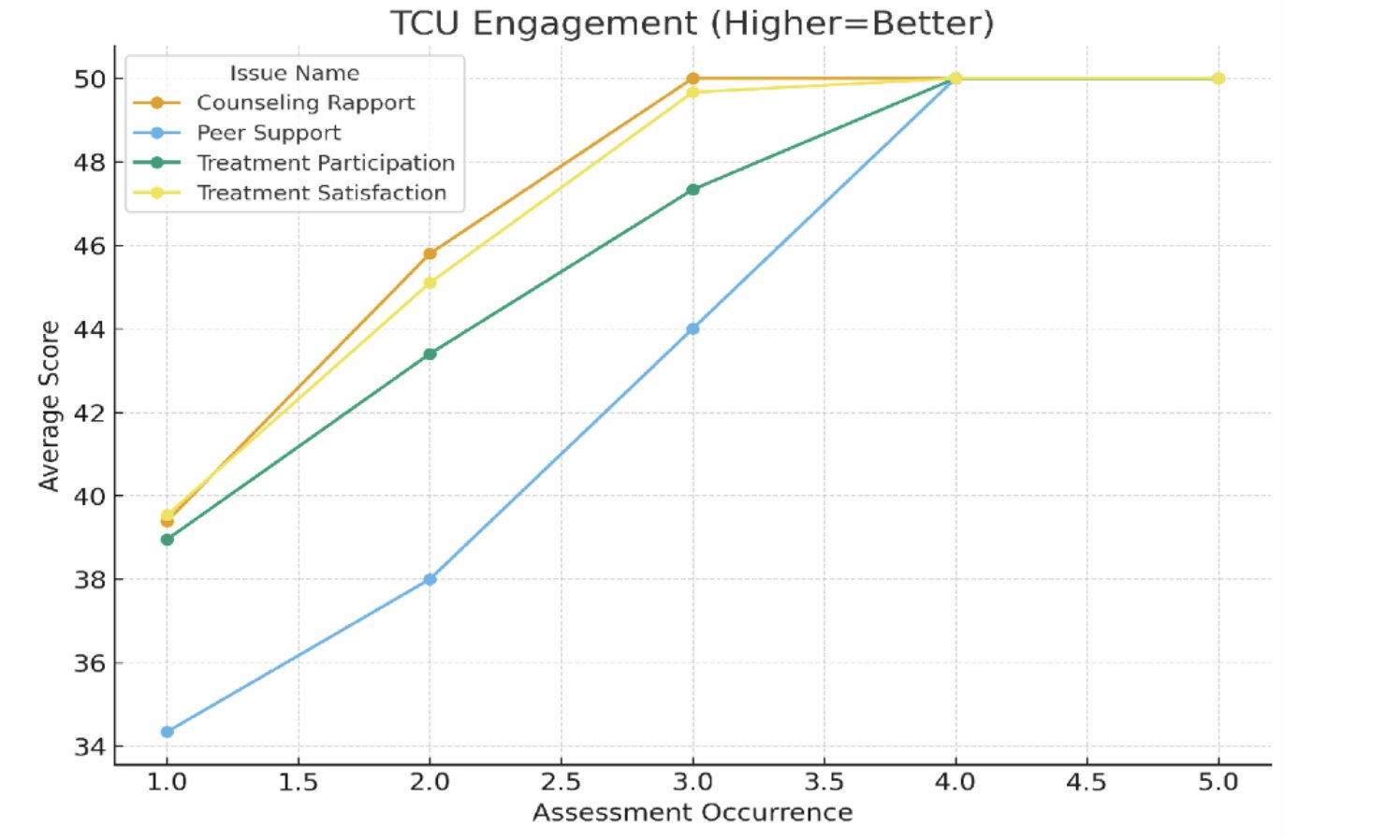
Graph features scores for all KBH counseling services, problem gambling included
Interested in learning more about our counseling services? Do you have additional questions about how we will measure your treatment progress? Or, are you ready to move forward with counseling, beginning with a FREE assessment for problem gambling and potentially cooccurring issues? Reach out via your preferred form of contact provided below.
Get Immediate and Effective Problem Gambling Support
CALL +1 (877) 426-4258
OR
Email help@kindbridge.com