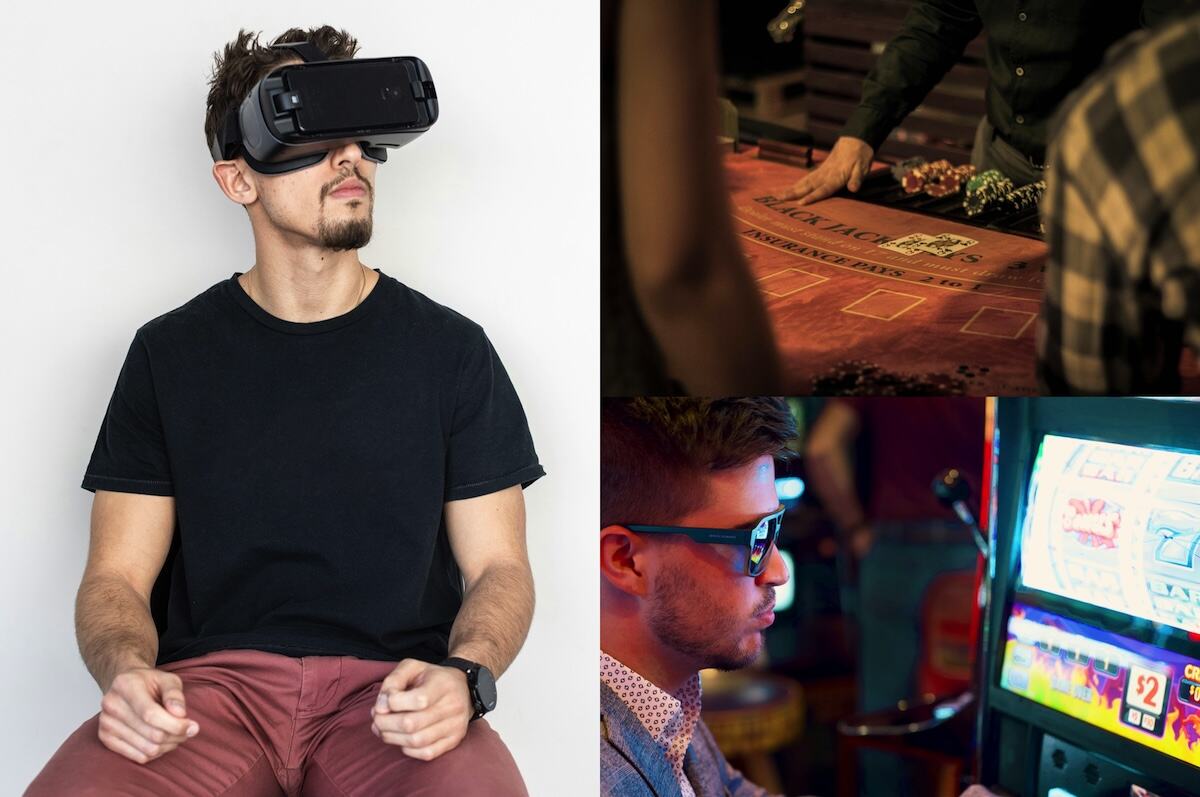
With cases of problem gambling rising across the nation, discussion about effective treatment strategies to combat the public health crisis is also experiencing exponential growth. One of the more headline-catching concepts being talked about of late, is virtual reality (VR) for gambling addiction treatment. It has gone so far that some early adopting providers of VR treatment for addiction are boldly purporting that it is more effective than traditional cognitive therapies. While far too early to make such erroneous claims, it is fair to ask – is VR consideration as a supplementary form of problem gambling treatment warranted? Let’s review.
Overview on Virtual Reality (VR) as a Supplement (not replacement) for Gambling Addiction Counseling
What is Virtual Reality Treatment for Addictive Behaviors?
Virtual Reality treatment for addictive behaviors is a form of therapy that simulates real-world environments and scenarios that exposes users/clients to triggers associated with their addictive behaviors. It provides participants with a safe and controlled virtual environment where which they can practice coping strategies and relapse prevention techniques.
Research Results on VR for Treating Other Addictive Behaviors
VR was first used to treat addiction in the early 2000s. Early research focused on using VR to expose patients to substance related stimuli in a controlled, safe environment. For instance, in the context of problematic alcohol use, VR simulations would trigger alcohol craving in subjects by placing them in VR environments such as at home in front of the TV, in a bar, restaurant, pub or nightclub. The intent of the research was a) to find out if the application of VR technology was adequate enough to induce palpable urges to drink, and b) discover if ongoing exposure to anxiety-provoking stimuli allowed participants to exercise their cognitive training and develop resilience to overcome triggers. For problematic alcohol use and substances (nicotine and stimulant drugs) VR has indeed shown to be somewhat effective at reducing use and cravings in an analysis of multiple studies. More so when paired with counseling and other proven treatments (view more here).
But what about problem gambling?
Recent Research on VR for Treating Gambling Addiction
Preliminary research on VR for treating problem gambling has been very limited. Early studies focused on whether or not problem gamblers experienced a compulsion to gamble when exposed to the triggers (virtual slot machines, a blackjack table, et cetera) in a simulated casino. These studies confirmed that this does occur, but little more had done in the way of research to determine if VR could be employed to treat problem gambling.
Until now.
Ongoing research conducted by the University of Connecticut (UConn) indicates that VR may have a place as a form of treatment for problem gambling. This research was spurred on by data indicating that its own student population was experiencing disproportionately high rates of problem gambling. An undergraduate survey found that 72% of UConn’s students gambled in the past year, and that 8.3% of respondents’ survey answers met the traditional definition of “serious problem gambling.” 17.2% reported problem gambling at a moderate level, exhibiting some negative consequences. In response, a UConn associate professor of psychological sciences launched an innovative project to curb student gambling via virtual reality. Expanding upon prior research on the matter, the professor asked participants to take a more “offensive” stance against triggers. Typically, cognitive training would help participants overcome triggers by retraining their brains’ automatic responses through techniques like cognitive restructuring and mindfulness. Instead of reacting impulsively, they would learn to identify triggers, challenge harmful thought patterns, and use grounding techniques to stay calm and present. But in this study, participants were instructed to seek out and destroy gambling-related triggers in the VR casino environment. How? By crushing slot machines and table games with a virtual hammer.
You know, like Whack-A-Mole.
The concept was actually inspired by the success of a previous VR smoking cessation study led by University of Quebec. Participants of that 2009 study searched for and crushed cigarettes in a VR simulation. Researchers found that individuals in the cigarette-crushing group displayed significant reductions in nicotine dependence and a significantly better abstinence rate (15% versus 2%). These participants also dropped out of treatment at a lower rate than those in the control group.
While the UConn study is currently ongoing, early indicators are positive:
“Data analysis will be completed this summer, but preliminary analyses indicate that after completing the VR intervention, participants show a reduction in gambling urges and a dramatic increase in their ability to avoid risky gambling behaviors. Once the full dataset is analyzed, it will hopefully show that “crushing” these stimuli in a virtual setting may weaken the student’s compulsion to gamble in the real world.” (August 25, 2025 | Uconn Today)
Why it May be a Supplement, Not a Replacement to Counseling
As America’s leading virtual (not virtual reality) treatment provider for problematic gambling behavior, we’re all for the application of technology to combat the current public health crisis. However, it’s critical to note that by no means should VR treatment for gambling addiction ever be considered to be a standalone solution, as some are already purporting it to be for other process addictions. Below is a brief summary of why.
i) Proven vs Unproven Methods
Cognitive behavior therapy (CBT) focuses on changing thought patterns to promote a healthier state of mind and body. CBT is proven in the realm of treating problematic gambling behavior in addition to the behavioral and mental health concerns that cooccur with it. There is decades of research to back it up, and our own treatment outcomes reports (view a sample) exhibit not just a reduction in scores for problem gambling, but a reduction in cooccurring issues for those who received customized treatment plans that address both. Here’s a snapshot of the data:
65.2% reduction in scores for cooccurring Depression
*Standard industry benchmark is 50%
76.5% reduction in scores for cooccurring Generalized Anxiety Disorder
*Standard industry benchmark is 50%
47.7% reduction in scores for cooccurring Alcohol Use Disorder
While there are some interesting and potentially promising findings for virtual reality cue exposure therapy (VR-CET) for gambling addiction, more studies need to be done to make more definitive claims. In fact, research has shown that even with alcohol abuse, where the most research on VR-CET has been applied, VR-CET remains to be less effective that CBT.
“Compared with other treatments, VR-CET achieved less favorable results in terms of craving reduction than the group using CBT […] Thus, the results of VR-CET’s effectiveness in reducing craving seem to vary according to the type of consumption, the combination with other treatments and the nature of the virtual stimuli. Further studies are needed to better understand the underlying mechanisms and optimize the use of VR in craving reduction.” (Science Direct)
ii) Coping Strategies and Techniques Must be Provided by a Qualified Therapist
In the first section, where VR treatment for addictive behaviors was defined, it was stated that the basis is founded in the fact that participants can practice coping strategies and relapse prevention techniques in a safe and controlled simulated environment. Where exactly are they to acquire these coping strategies and techniques to overcome triggers? Proponents of VR-only treatment may point to predetermined strategies for overcoming triggers, which can be beneficial, but they will not always account for the nuances of an individual participant’s background, experiences, vulnerabilities, and psychological wellbeing. Boilerplate strategies may not be able to adequately address issues that often cooccur with problem gambling, such as ADHD, anxiety, bipolar disorder, depression, OCD, and PTSD. It is therefore extremely important for a given individual to first enter into an assessment and receive subsequent treatment from a counselor who specializes in the identifying and treating problematic gambling behavior along with comorbid concerns. This will ensure that an individual is empowered with the tools needed to confront triggers in the real…and virtual world.
iii) Simulating Online Gambling More Challenging?
It’s easy enough (in the VR world) to create a brick-and-mortar gambling environment (casino, race track, or sports bar) that feels real to those using VR to manage exposure to triggers. It is more challenging when it comes to online casino gaming and online sports betting, because to do so designers would be creating a virtual environment within a virtual environment, adding another layer of complexity that neural pathways may struggle to perceive as being real enough to reform behaviors. This is not to suggest that it’s not possible, but circling back to what we stated above, this challenge places VR treatment further into unproven territory. Consequently, those who struggle with problem gambling should at no point abandon virtual counseling for virtual reality treatment. The latter may one day be a supplement, but it will never be a replacement for the former.
Again, research on virtual reality treatment for gambling addiction is in an infancy stage. In the same manner that we follow and report of the application of various technologies in fighting problem gambling (such as artificial intelligence) we will follow developments of the most recent UConn study and more. Until then, if you or a loved one struggles with problem gambling, reach out to America’s proven treatment provider via your preferred form of contact below.
Get Help for Problem Gambling Today
CALL +1 (877) 426-4258
OR
Email help@kindbridge.com