The World Health Organization (WHO) states that anxiety disorders are the world’s most common mental disorders, with recent reports indicating that they affect nearly 360 million people, just over the population count of the United States of America. Meanwhile, the National Alliance on Mental Illness (NAMI) confirms that about 19% of Americans live with an anxiety disorder. There are six types of the condition with varying signs and symptoms (view here) although there are a number of categories within. For instance, during uncertain economic and sociopolitical times reports of anticipatory anxiety are on the rise.
Demand for therapy to help manage anxiety is also growing, as is the curiosity about more accessible and convenient alternatives to in-person treatment. This interest is currently manifesting as a large volume of Google and ChatGBT search for “Does online counseling help with anxiety?”. As a leading virtual counseling service for anxiety, Kindbridge Behavioral Health has access to data regarding treatment outcomes. As 2025 comes to a close we are happy to share measurable results for those seeking immediate treatment for anxiety in a manner that better suits challenging schedules and day to day responsibilities.
Recent Treatment Reports on Client Engagement and DASS-21 Scores Indicate Positive Outcomes for Those in Counseling for Anxiety
What DASS-21 Scores Say
The varying forms of anxiety often cooccur with chronic stress and depression. Accordingly, leading treatment providers employ the Depression, Anxiety, and Stress Scale-21 (DASS-21) to help assess the effectiveness of anxiety counseling.
The DASS-21 is a 21-item self-report questionnaire that measures the severity of symptoms for depression, anxiety, and stress. Participating clients rate how often they experienced symptoms over a recently concluded assessment period, using a 4-point scale to select predefined answers to questions with corresponding scores. For instance, when a question is posed as it relates to feelings and emotions during their therapeutic journey, respondents may select “Never (0-points)”, “Sometimes (1-point)”, “Often (3-points)”, “Almost Always (4-points)”. The values are tabulated to determine outcomes of treatment for depression, anxiety, and stress. Determination of success in anxiety treatment is partially marked by reductions in DASS-21 scores.
To provide an answer to the question of “Does online counseling help with anxiety?” we now look to the results of Kindbridge’s recent quarterly Treatment Outcomes report for clients who have entered into counseling for overall (anxiety, stress, depression) mental/behavioral health.
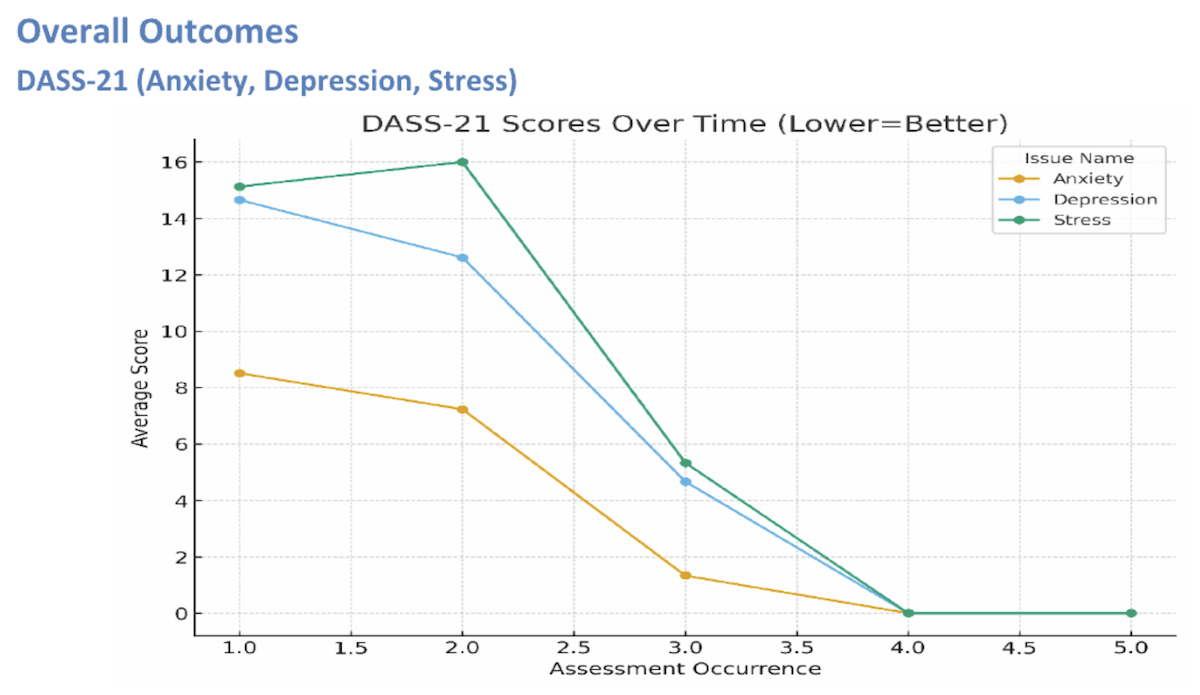
The table below shows the four scales used in measuring DASS-21 scores. Scores are provided over five separate assessments of KBH clients in counseling. The scores below are approximations, rounded to the nearest value.
*At press (Q3 2025) Assessment 4 and 5 are pending and will be added at the end of 2025. Bookmark this page and return at the end of Q4 2025 for final results.
| RESPONSE | Assessment 1 Score | Assessment 2 Score | Assessment 3 Score | Assessment 4 Score | Assessment 5 Score |
| Anxiety | 9 | 7 | 1 | – | – |
Scores for “anxiety” declined significantly from Assessment 1 through 3, which is a pattern expected to maintain into Assessment 4 and through to Assessment 5.
What Engagement Rates Say
Another palpable measurement to reference are engagement rates. They refer to how often clients participate in services along with their active involvement, commitment, and emotional connection to the therapeutic process.
Kindbridge uses TCU Treatment Engagement Data as a key component of measuring outcomes. The TCU Treatment Engagement Form (ENGForm) is a self-report assessment to measure client engagement. It consists of three-dozen items across four scales, including the following:
- Treatment Participation: This assesses and tracks how actively clients are participating and engaging in their treatment.
- Treatment Satisfaction: This provides a more comprehensive picture of a client’s progress and the effectiveness of care.
- Counselor Rapport: This references the therapeutic relationship and/or emotional connection a counselor builds with a client, characterized by agreement, mutual understanding, and a harmonious relationship.
- Peer Support: This references engagement in a supportive environment (i.e. group counseling) where clients connect with peers regarding shared behavioral/mental health issues.
These scales are used to inform treatment planning and track changes in client engagement over time. They are scored on a range from 10 to 50 and use Response Mapping that references 5-point scores (1 = “strongly disagree” to 5 = “strongly agree”) that are averaged and then multiplied by 10 to produce the final score. Scores above 30 suggest that a client is largely in agreement with the positive statements associated with that scale, while scores below 30 indicate that the client is largely in disagreement with the positive statements. Higher scores reflect a stronger level of engagement while lower scores suggest a lower level of engagement.
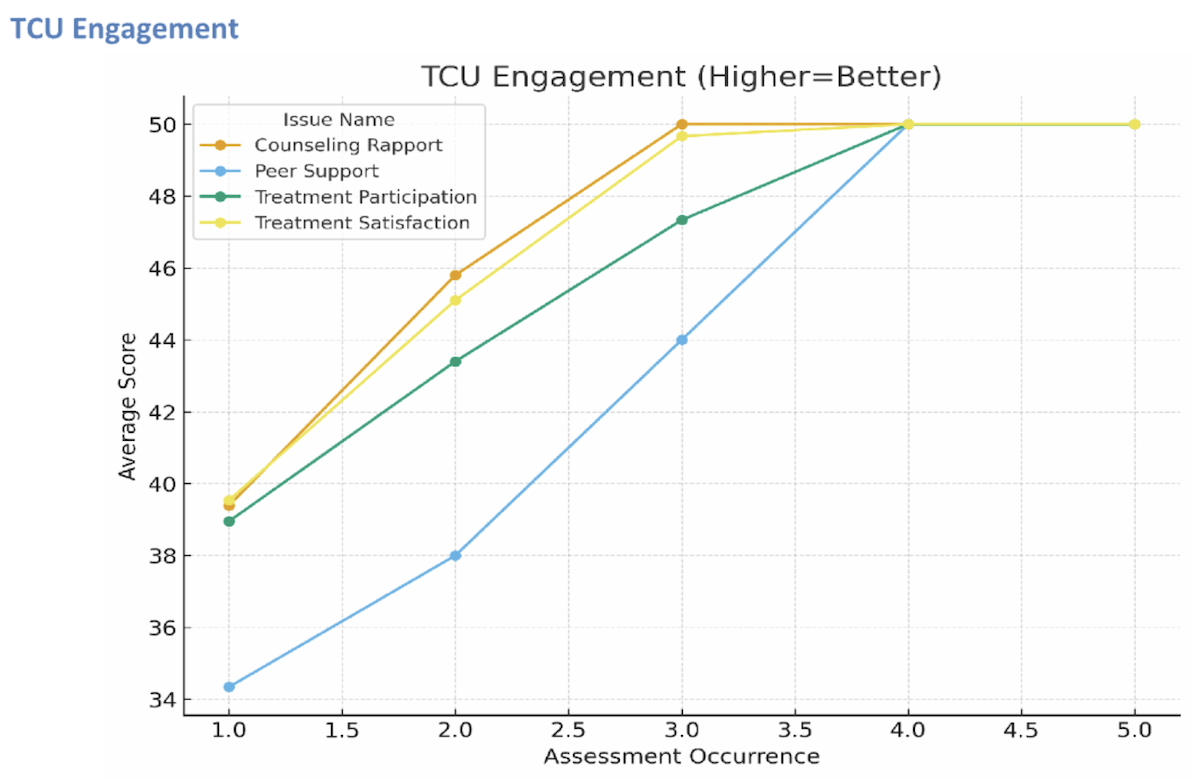
As with DASS-21 scores referenced in the previous section, we look to engagement rate results of the most recent quarterly Treatment Outcomes report for clients who have entered into counseling for overall (anxiety, stress, depression) mental/behavioral health. The table below shows the four scales used in measuring engagement, taken over four separate assessments during a specified quarter of 2025.
*Scores below are approximations, rounded to the nearest value.
| SCALE | Assessment 1 Score | Assessment 2 Score | Assessment 3 Score | Assessment 4 Score |
| Counselor Rapport | 39 | 46 | 50 | 50 |
| Peer Suport | 34 | 38 | 47 | 50 |
| Treatment Participation | 39 | 43 | 47 | 50 |
| Treatment Satisfaction | 39 | 45 | 50 | 50 |
Scores improved significantly from Assessment 1 through 4, indicating success for clients in counseling for anxiety and cooccurring issues.
Current client results speak for themselves, but now it’s time to get the help YOU need. Begin your journey to being free from anxiety with a FREE assessment. Connect to a care coordinator via your preferred form of contact provided below.
Learn to Overcome Anxiety Through Online Counseling
CALL +1 (877) 426-4258
OR
Email help@kindbridge.com