
According to a 2025 Gallup Poll, more than 18% of Americans (almost 48 million people) struggle with depression. This historical high is more than double that of the rate from a half-decade ago, spurred on by the national response to the global health crisis from 2020-21. Higher than normal rates of depression have persisted late into 2025. Why does it maintain? Continued economic and sociopolitical uncertainty likely plays a role. The proliferation of digital technology that enables seamless engagement with unhealthy coping mechanisms (i.e. online gambling, et cetera) that are comorbid with depression may also contribute to the crisis.
Depression comes in varying forms (view here), ranging from mild to severe, with signs and symptoms that extend from slightly disruptive to outright debilitating, even dangerous. The relatively rapid growth of depression in the United States has led to a corresponding increase in demand for treatment services. With this demand exceeding availability of local in-person therapy, millions of Americans are exploring online counseling as an option. While clearly more accessible, convenient, and often more affordable, those who desperately want to escape the clutches of depression ask; “Does online counseling help with depression?”. To answer this important question our virtual counseling platform has the benefit of avoiding generalized responses by pulling from data. As a leading provider of online counseling for depression we track progress of clients with measurable data not just to inform ongoing treatment, but to provide feedback to the public about the efficacy of online counseling. Read ahead for an overview of the most recent stats from Kindbridge Behavioral Health.

2025 Treatment Reports Indicate Positive Outcomes for Those Engaging in Online Counseling for Depression
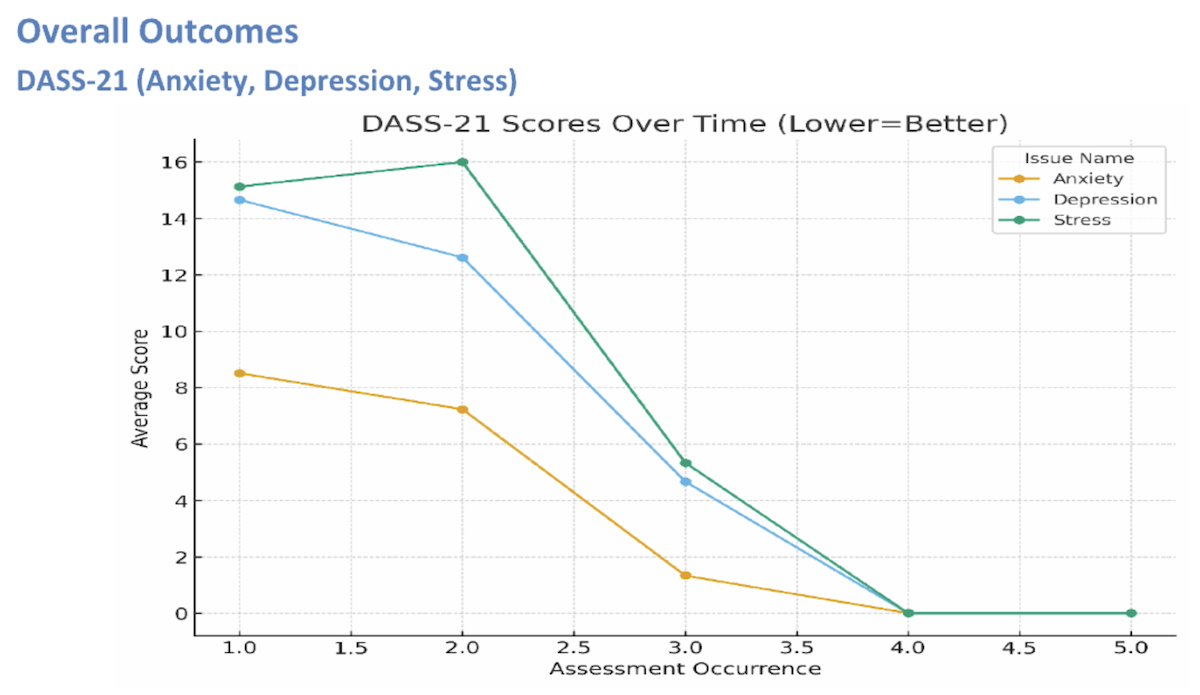
DASS-21 Results for Depression Treatment
Depression in its various forms often cooccurs with chronic stress and anxiety. For this reason, leading treatment providers employ the Depression, Anxiety, and Stress Scale-21 (DASS-21) to help assess the effectiveness of depression counseling.
The DASS-21 is a shortened (21-item) version of a full 42-item scale and is used to screen for mental health conditions and monitor symptoms over time. Participants rate how much each statement applies to them over an assessment period using a scale (generally 0-3 or 0-4). The scores for each of the subscales are then multiplied to arrived at a final score from which conclusions about efficacy are drawn.
To provide an answer to the question of “Does online counseling help with depression?” we now look to the results of Kindbridge’s recent quarterly Treatment Outcomes report for clients who have entered into counseling. The table below shows the four scales used in measuring DASS-21 scores. Scores are provided over five separate assessments of Kindbridge clients in counseling. The scores below are approximations, rounded to the nearest value.
*At press (Q3 2025) Assessment 4 and 5 are pending and will be added at the end of 2025. Bookmark this page and return at the end of Q4 2025 for final results.
| RESPONSE | Assessment 1 Score | Assessment 2 Score | Assessment 3 Score | Assessment 4 Score | Assessment 5 Score |
| Depression | 15 | 13 | 5 | – | – |
Scores for “depression” declined significantly from Assessment 1 through 3, with a very notable improvement from Assessment 2 to Assessment 3. This beneficial pattern is expected to maintain through Assessment 4 and Assessment 5.
Engagement Rate Results for Depression Treatment
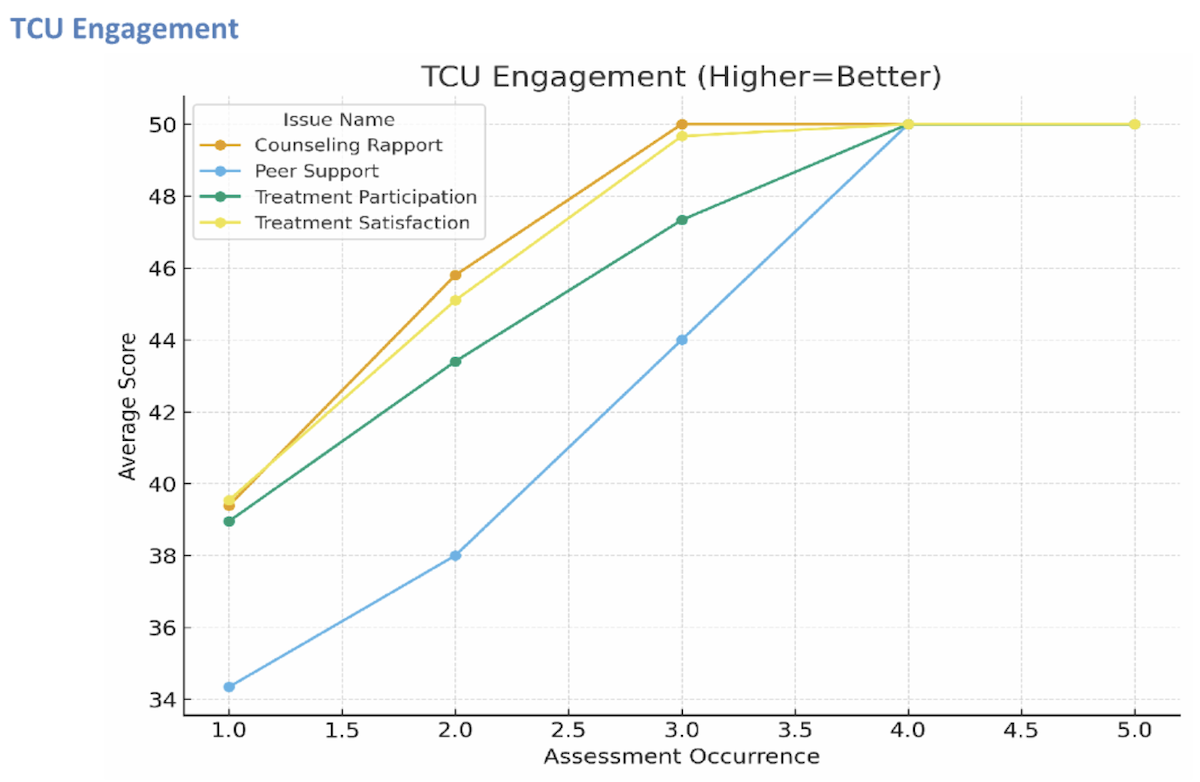
Another measurement to gauge the efficacy of online counseling for depression is the collective client engagement rate. Engagement rates refer to how often clients participate in services along with their active involvement, commitment, and emotional connection to the therapeutic process.
The TCU Treatment Engagement Data as a key component of measuring outcomes. The TCU Treatment Engagement Form (ENGForm) is a self-report assessment to measure client engagement. It consists of three-dozen items across four scales, including the following:
- Treatment Participation: This assesses and tracks how actively clients are participating and engaging in their treatment.
- Treatment Satisfaction: This provides a more comprehensive picture of a client’s progress and the effectiveness of care.
- Counselor Rapport: This references the therapeutic relationship and/or emotional connection a counselor builds with a client, characterized by agreement, mutual understanding, and a harmonious relationship.
- Peer Support: This references engagement in a supportive environment (i.e. group counseling) where clients connect with peers regarding shared behavioral/mental health issues.
These scales are scored on a range from 10 to 50 and use Response Mapping that references 5-point scores (1 = “strongly disagree” to 5 = “strongly agree”) that are averaged and then multiplied by 10 to produce the final score. Scores above 30 indicate that a client is largely in agreement with the positive statements associated with that scale, while scores below 30 suggest that the client is largely in disagreement with the positive statements. Higher scores reflect a stronger level of engagement while lower scores suggest a lower level of engagement.
As with DASS-21 scores referenced in the previous section, we look to engagement rate results of the most recent quarterly Treatment Outcomes report for clients who have entered into counseling. The table below shows the four scales used in measuring engagement, taken over four separate assessments during a specified quarter of 2025.
*Scores below are approximations, rounded to the nearest value.
| SCALE | Assessment 1 Score | Assessment 2 Score | Assessment 3 Score | Assessment 4 Score |
| Counselor Rapport | 39 | 46 | 50 | 50 |
| Peer Suport | 34 | 38 | 47 | 50 |
| Treatment Participation | 39 | 43 | 47 | 50 |
| Treatment Satisfaction | 39 | 45 | 50 | 50 |
Scores improved significantly from Assessment 1 through 4, indicating success for clients in counseling for depression and cooccurring issues.
WHO-5 Well-Being Results as a Metric in Depression Treatment
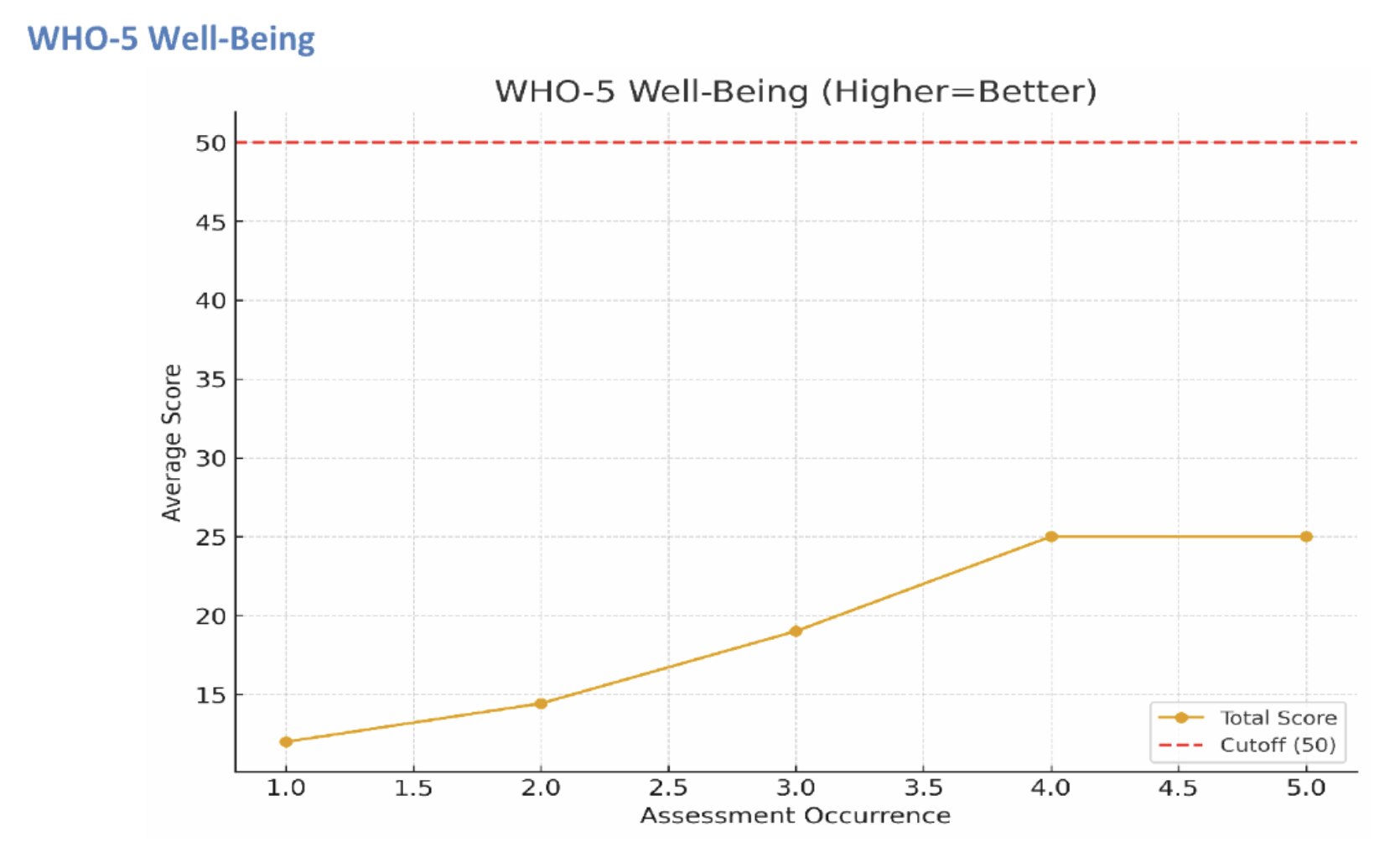
The World Health Organization’s Five Well-Being Index (WHO-5) is a short, 5-question self-report questionnaire that is used to measure mental well-being. It inquires about positive moods and vitality over an assessment period, and uses a point scale for each item to create a final score, where higher scores indicate better mental well-being. The index is also used by Kindbridge to screen for depression and assess general well-being. The graph below shows a steady improvement from Assessment 1 to 3.
*At press (Q3 2025) Assessment 4 and 5 are pending and will be added at the end of 2025. Bookmark this page and return at the end of Q4 2025 for final results.
Current client results speak for themselves, but now it’s time to get the help YOU need. Begin your journey to being free from depression with a FREE assessment. Connect to a care coordinator via your preferred form of contact provided below.
Learn to Overcome Depression Through Online Counseling
CALL +1 (877) 426-4258
OR
Email help@kindbridge.com