
The American Institute of Stress reports that nearly half of Americans experience significant daily stress (aka chronic stress). Numerous surveys indicate that the United States consistently has one of the highest rates of chronic stress among high-income nations of the world. The numerous signs and symptoms (view here) are prevalent in Americans from all walks of life, from college students and stay-at-home parents to budding entrepreneurs and CEOs of large enterprises.
Generations prior lived with stress without therapeutic intervention to their detriment. Thankfully, things have changed, especially over the last half-decade. However, while people are now more likely to seek professional help to manage the mind and body’s reaction to life’s perceived challenges and demands, those who remain on the fence are skeptical about the effectiveness. This is particularly true of virtual services. Despite greater accessibility and convenience (helpful for those stressed by responsibilities) when compared to traditional on-premises therapy, there is an ironic perception that it may be less effective. The good news, is that many (yourself included) have an open mind and perform a search for “Does online counseling help with stress?” to assist in their decision about engaging in virtual services.
While there are numerous research-backed articles (view here) showing the proven advantages to virtual services, we are taking a more head-on approach in today’s feature. As one of the nation’s leading online counseling services for stress we have the benefit of analyzing data regarding treatment outcomes for clients. Recent data speaks for itself, which we are happy to share with you in response to the query that brought you here.
Recent 2025 Treatment Reports on Client Engagement and DASS-21 Scores Indicate Positive Outcomes for Those in Counseling for Stress
What DASS-21 Scores Say
Chronic stress often cooccurs with varying forms of anxiety and depression. For this reason, many experts (Kindbridge included) employ the Depression, Anxiety, and Stress Scale-21 (DASS-21) to help assess the effectiveness of stress treatment.
The DASS-21 is a 21-item self-report questionnaire designed to measure the severity of symptoms for depression, anxiety, and stress in adults. Individuals rate how often they experienced symptoms over the past assessment period, using a 4-point Likert-scale that allows them to indicate responses such as “Did not apply to me at all” to “Applied to me very much or most of the time”. The form typically features words and corresponding scores of “Never (0)”, “Sometimes (1)”, “Often (3)”, “Almost Always (4)” to delineate responses. The values are tabulated to determine outcomes of treatment for depression, anxiety, and stress. Determination of success in stress treatment is partially marked by reductions in DASS-21 scores.
With a clearer picture of what DASS-21 in the context of stress counseling is, and how it is measured, we now look to the results of the most recent quarterly Treatment Outcomes report for clients who have entered into counseling for overall (anxiety, stress, depression) mental/behavioral wellness.
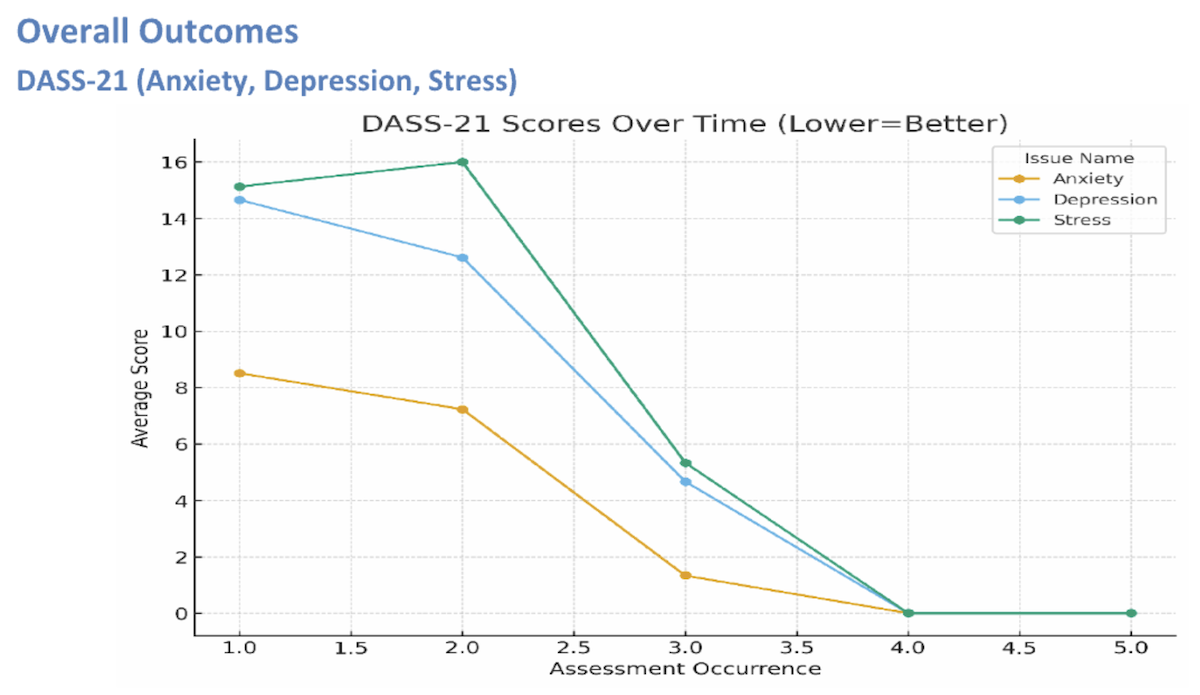
The table below shows the four scales used in measuring DASS-21 scores, taken over five separate assessments (during a specified quarter of 2025) of KBH clients in counseling.
*Scores below are approximations, rounded to the nearest value. At press (Q3 2025) Assessment 4 and 5 are pending and will be added at the end of 2025.
| RESPONSE | Assessment 1 Score | Assessment 2 Score | Assessment 3 Score | Assessment 4 Score | Assessment 5 Score |
| Stress | *15 | 16 | *5 | – | – |
Scores for “stress” declined significantly from Assessment 1 through 4 and maintained through to Assessment 5. Why the slight increase from Assessment 1 to 2? In some cases, individuals may experience increased stress at the beginning of counseling before feeling better. This initial spike, sometimes called a “therapy hangover,” is typically a sign that deep and meaningful work has begun. Ultimately, therapy should lead to an overall reduction in stress over time as an individual develops healthy coping mechanisms and gains a new perspective.
What Engagement Rates Say
Another important measurement to look at in your search for insight into “Does counseling help with stress?” are engagement rates/scores. These refer to how often individuals participate in services, such as attending therapy sessions or using a digital mental health tool. It can also describe a client’s active involvement, commitment, and emotional connection to the therapeutic process.
Kindbridge uses TCU Treatment Engagement Data as a key component of measuring client outcomes. The TCU Treatment Engagement Form (ENGForm) is a self-report assessment to measure client engagement. It consists of three-dozen items across four scales, including the following:
- Treatment Participation: This assesses and tracks how actively clients are participating and engaging in their treatment.
- Treatment Satisfaction: This provides a more comprehensive picture of a client’s progress and the effectiveness of care.
- Counselor Rapport: This references the therapeutic relationship and/or emotional connection a counselor builds with a client, characterized by agreement, mutual understanding, and a harmonious relationship.
- Peer Support: This references engagement in a supportive environment (i.e. group counseling) where clients connect with peers regarding shared behavioral/mental health issues.
These scales are used to inform treatment planning and track changes in client engagement over time. They are scored on a range from 10 to 50 and use Response Mapping that references 5-point scores (1 = “strongly disagree” to 5 = “strongly agree”) that are averaged and then multiplied by 10 to produce the final score. Scores above 30 suggest that a client is largely in agreement with the positive statements associated with that scale, while scores below 30 indicate that the client is largely in disagreement with the positive statements. Higher scores reflect a stronger level of engagement while lower scores suggest a lower level of engagement.
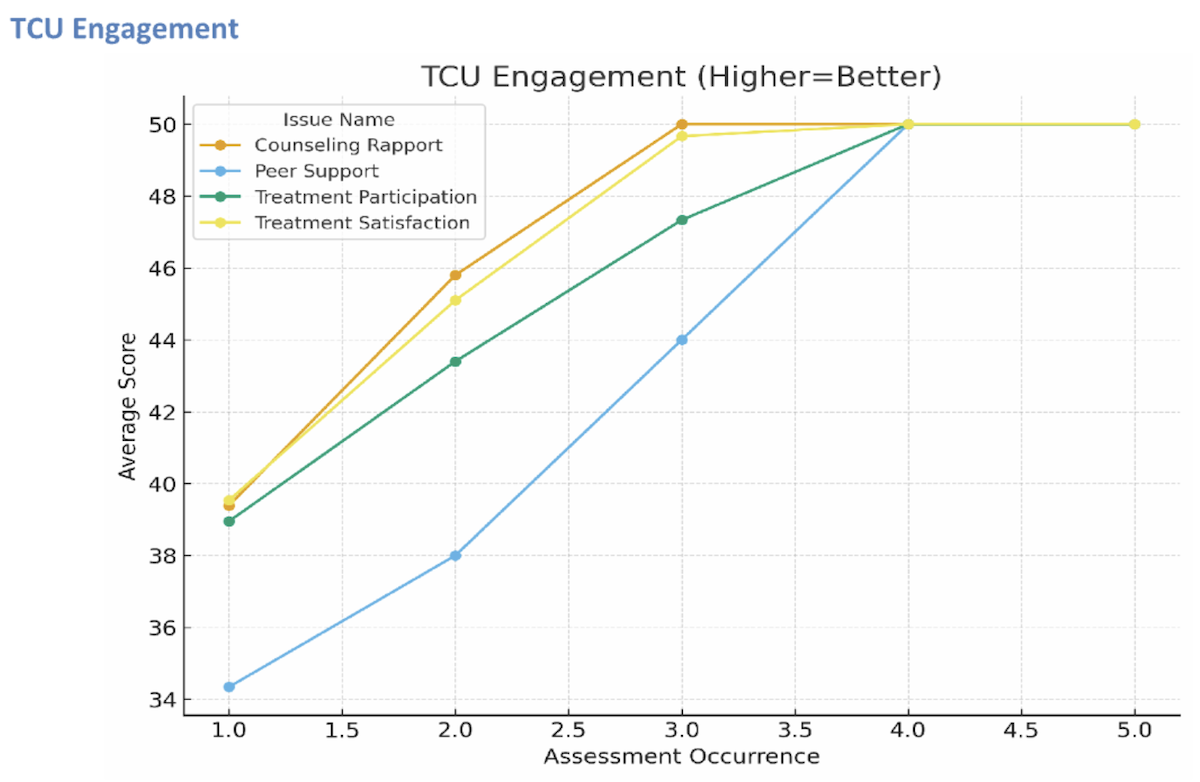
Let’s now look to the results of the most recent quarterly Treatment Outcomes report for clients who have entered into counseling for overall (anxiety, stress, depression) mental/behavioral health and wellness. The table below shows the four scales used in measuring engagement, taken over four separate assessments (during a specified quarter of 2025) of KBH clients.
*Scores below are approximations, rounded to the nearest value.
| SCALE | Assessment 1 Score | Assessment 2 Score | Assessment 3 Score | Assessment 4 Score |
| Counselor Rapport | 39 | 46 | 50 | 50 |
| Peer Suport | 34 | 38 | 47 | 50 |
| Treatment Participation | 39 | 43 | 47 | 50 |
| Treatment Satisfaction | 39 | 45 | 50 | 50 |
Scores for improved significantly from Assessment 1 through 4.
Interested in learning more about our counseling services? Or, are you ready to move forward with counseling, beginning with a FREE assessment for chronic stress and potentially cooccurring issues? Reach out via your preferred form of contact provided below.
Learn to Overcome Stress Through Online Counseling
CALL +1 (877) 426-4258
OR
Email help@kindbridge.com