
While the majority of U.S. states have legalized and now regulate land-based and online sports betting, California remains in the minority of those who have not. However, many speculate that a transition is inevitable given that state and local government entities in California have issued more than $2 trillion in debt over the last four decades. Proponents for regulation of the gambling activity point to the potential for tax revenue to reduce this debt and to support a variety of social welfare concerns. Taking notice, tens of thousands of state residents and stakeholders frequently type “When will sports betting be legal in California?”. There is no clear cut answer to this query, but as the leading problem gambling support provider in the United States, Kindbridge Behavioral Health points to a number of issues that surround progress (or lack thereof) regarding legalization. Read ahead for a detailed overview of sports betting in California, complete with a look at the nuances regarding what currently is and isn’t allowed with respect to adjacent industries along with a concluding look at the need for increased mental health support services.
*Bookmark this article as it will be updated in real time as developments regarding legal sports betting in California unfold in the weeks, months, and potentially years to come.
Overview of Sports Betting in California, When (or if) it Will Become Legal, and How Mental Health Factors into the Equation
Does California Allow Sports Betting?
Despite the 2018 Supreme Court removal of the federal ban on sports betting, the gambling activity remains illegal in the state of California. Ongoing negotiations in the California State Legislature with the California Nations Indian Gaming Association (CNIGA) have not resulted in a resolution among entities interested in providing sports wagering, including online sportsbooks.
Proposal to Make Sports Betting Legal in California
The most recent move to legalize traditional sports betting in California was Proposition 27 (2022). Passage of Prop 27 would have allowed sports betting companies to offer online sports betting, with a portion of revenues being allocated to the state for social services, namely to support state regulatory costs and to address homelessness. Prop 27 would also have created a new online sports betting regulatory unit, and provide strategy to reduce unregulated forms of online sports betting in the state, which are addressed in the following sections. Three years ago, California tribes invested more than $200 million into defeating Prop 27 in order to keep U.S. sports betting operators from reaping rewards that they felt (and feel) would impede upon their rights to maintain domain over all gambling operations in the state.
As of Q2, 2025, a return to the ballot of Prop 1A (passed in 2000) to amended the constitution to legalize sports betting through compacts with Native American tribes would be required to finally legalize sports betting in the state. Ultimately, the creation of a single entity containing all of California’s recognized tribes with a contract to include online sports betting platforms (that are regulated in other U.S. states) is the only way forward. These operators would likely carry the cost for any statewide initiative. Under this scenario, the answer to “When will sports betting be legal in California?” would be met with a reply of late 2026, at best. Experts suggest that the most likely scenario is the passage of legal sports betting in 2027, with the first regulated operator accepting players in 2028. Despite this, there are other forms of sports betting occurring in California, which are detailed in the sections below.
Is Daily Fantasy Sports Legal in California?
Again, California is among the 10 states (view map) that have not legalized traditional sports betting. Thus far, online daily fantasy sports (DFS) sites have not been defined as traditional sports betting and therefore a number of DFS platforms have been able to operate in the grey area in the Golden State. More reputable DFS operators, however, have chosen to await clarity before accepting players in California. The two largest DFS platforms in the United States – DraftKings and FanDuel – are not currently operating in the state. At press, it seems that they have made the right decision because in July of 2025, California Attorney General, Rob Bonta, made it clear that in his opinion DFS contests, including both draft-style and pick-’em games, constitute illegal gambling under California law. Bonta’s declaration is backed by California Nations Indian Gaming Association (CNIGA) tribal leaders who suggest that current DFS operators are in clear violation of law.
Forms of Sports Betting Tolerated in California
There are forms of sports betting in California that are not outright legal, per se, but are being tolerated due to a variety of loopholes used by the respective online platforms. These include the following:
i) Sweepstakes Sportsbooks / DFS
The sweepstakes (or “social”) gambling concept was first introduced as a gateway to offer U.S. citizens online casino gaming in the vast majority of states that do not allow online casinos (view map here). California is among those states. These platforms are no different than traditional online casinos, although they hide the real money angle under the guise of coins., tokens, and prizes. Instead of offering players real money rewards (or losses) for playing online slots and table games, they keep the concept for winning (or losing) by gambling at an arm’s length. Players initiate participation for free, but may also purchase virtual coins or tokens to keep playing and increase their win totals. As win totals are accumulated, players can exchange their coins or tokens for real money. This intermediary is what allows operators to sidestep U.S. government regulation. It was only a matter of time since inception that the concept would be applied to the sports betting market.
Sweepstakes sportsbooks and social DFS platforms operate under the same casino model, offering California residents the option to purchase virtual currencies such as “sweepstakes coins” which are used to make sports game/event picks and predictions. These coins can be exchanged for cash prizes or gift cards if/when a player wins, or lose the investment when picks and predictions don’t go a players way (more often than not).
It’s pretty clear that the sweepstakes model is a form of sports betting, which is why the same California tribal leaders targeting DFS argue that sweepstakes platforms also infringe on their exclusive right to offer gambling under California’s constitution. The recently updated California Assembly Bill 831 (AB 831) aims to ban sweepstakes casinos in the state by closing a loophole related to online sweepstakes games that offer real cash payouts. Recent enforcement actions and political pressure offer momentum for the bill, which you can reference in greater detail via the link below:
AB-831 Gambling: Operation of a Contest or Sweepstakes
ii) Sports Trading
Prediction markets are exchange-traded platforms where individuals can “invest” on the outcome of a variety of events with an unknown future. Members can make “Yes / No” predictions on items such as weather events, political elections, box office results of Hollywood film releases, and as of the first fiscal quarter of 2025 – sporting events. Prediction market investment in sporting event outcomes is now referred to as “sports trading” and as with the sweepstakes gambling model it has been able to sidestep California gambling regulations. As expected, this too is under the scrutiny of California Attorney General and the CNIGA. On July 23, 2025, three Native American tribes in California launched a lawsuit against Kalshi and Robinhood (two top sports trading platforms) over what it claims is illegal sports betting. These operators have also received cease and desist letters from regulators in Maryland, Illinois, Montana, Nevada, New Jersey, and Ohio. Results of the current California lawsuit are pending. View more on the rise of sports trading and problematic use with these platforms via the link below:
Is Sports Trading Addiction America’s Newest Gambling Threat?
Unregulated Offshore Sports Betting in California
At press, a quick Google News search for updates on “sports betting california” does not deliver legitimate reports from trustworthy media (an oxymoron?) but a paid-for press release (advertorial) from one of the biggest unregulated offshore sportsbooks to infiltrate the state of California – BetOnline:
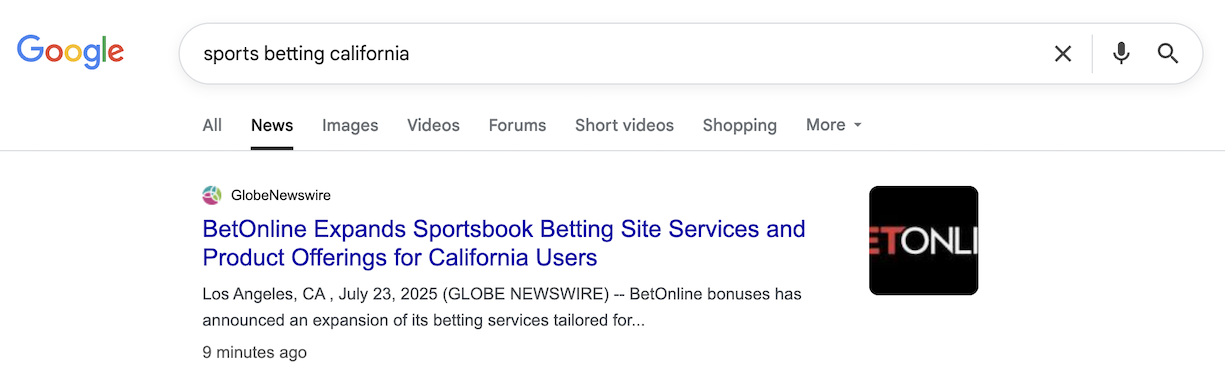
This manipulative tactic is used by the offshore sports betting market (BetOnline, BetUS, Bovada, etc.) to essentially trick state residents into thinking that sports betting is legal in California. BetOnline even sponsors professional surfers to make it seems as if they are a legitimate operation.
The infiltration of unregulated offshore sportsbooks further confuses a population base that searches for details as to when will sports betting be legal in California. This not only frustrates those who want a clear cut answer, it places vulnerable members of the population at risk. How? BetOnline and other offshore operators do not have the required guardrails in place to monitor for problematic gambling behavior among players, nor do they have robust self-exclusion programs that connect compromised players to mental health support services (more on this in the next section). View more on the dangers of the offshore market that California sports bettors need to be aware of via the link below:
Dangers of Unregulated Sports Betting
Sports Betting Addiction Statistics for California
Research from the California Council on Problem Gambling indicates that approximately 83% of adults (21 and over) in the state are gamblers, and that approximately 3.7% of the population are problem gamblers. If the statistics hold true, about 1.2 million Californians may have a problematic relationship with gambling.
Further insight can be gained by referencing current online search that is occurring from within California. This data is very useful because it provides a snapshot regarding the volume of concern coming from the public, and the language they use when reaching out for support. Have a look at the table below:
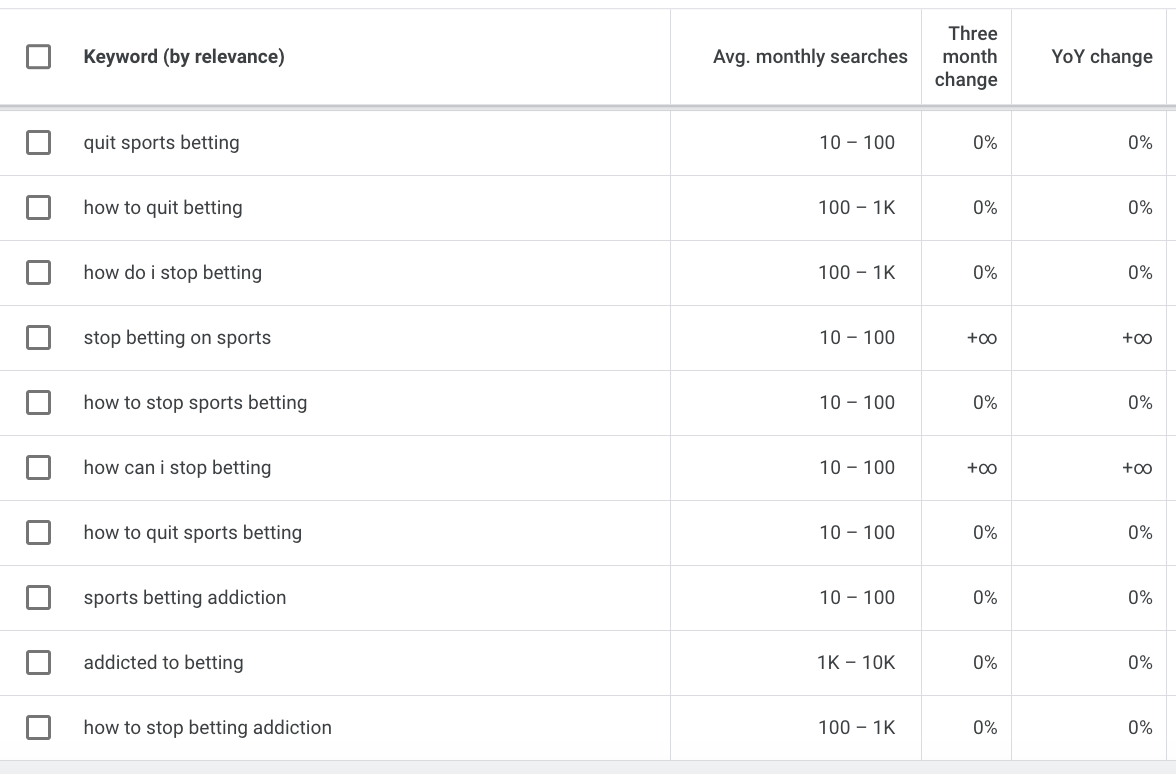
Source: Google Keyword Planner (California)
What the Numbers Mean: The numbers in the table above indicate the average online search volume for each expression (with California) which are delineated as 10-100, 100-1000, and 1000-10000 Google searches per month. Note that these are averages, and can move dramatically upward in response to a given event or phenomenon. A “+ ∞” (positive infinity) appended to any phrase indicates a significant-to-extremely high positive growth in search volume. All statistics regarding online search data above is referenced from Google’s Keyword Research tool.
The above search volume data is just a snapshot of how California residents search for help to quit sports betting, as there are numerous other semantic variations being searched every day, week, and month. Should the sports betting market open even wider in California, the demand for sports betting addiction treatment is expected to grow exponentially, straining existing support service resources. This leads to the next and final section.
Sports Betting Addiction Support in California
In response to the rising demand for sports betting addiction treatment in California, Kindbridge Behavioral Health has stepped up to offer residents direct access to support services. Our counselors not only treat sports betting addiction, but all forms of problematic gambling behavior in addition to cooccurring mental health concerns. Our confidential and effective virtual treatment platform is accessible anytime and from anywhere, be it for residents of Los Angeles County (view here), San Diego County (view here) or anywhere else in the Golden State.
*Bookmark this article as it will be updated in real time as developments regarding legal sports betting in California unfold in the weeks, months, and potentially years to come.
If you or a loved one struggle with problematic sports betting in any shape or form, reach out to Kindbridge right away to get help.
Get Help for Problem Gambling Today
CALL +1 (877) 426-4258
OR
Email help@kindbridge.com