
At press, the 2025 National Football League (NFL) regular season is in full swing. While the single biggest day in sports betting may be the league’s season ender, the first entire week of NFL football typically drives more revenue than the Super Bowl and all other sporting events on the planet. It also establishes a benchmark for industry revenue predictions. How NFL Week 1 plays out among sportsbooks and daily fantasy sports (DFS) operators sets expectations for what’s to come for the other big events on the sports betting calendar, including but not exclusive to Thanksgiving weekend football, NCAAF bowl season, the CFB playoff, and NCAAB March Madness. And while Week 1 handle (total amount wagered) for the 2025 NFL season will not be reported for weeks or months after the games are played, the American Gaming Association (AGA) estimates that the total wagering for the entire 2025 NFL season could reach $30 billion, which puts NFL Week 1 on pace to be a record breaker. NCAA football is also seeing a massive spike, with their own Week 1 creating a windfall for operators as the sports betting public “got crushed” as final tallies came in (view reports) last week.
But of course, the AGA only reports on legally wagered handle, which does not account for the handle on NFL or NCAAF from the offshore market. Remember, nearly 90% of all American wagers on prior Super Bowls (even after sports betting had been legalized in most states) have been made on the unregulated market. It can therefore be inferred that money wagered on American football with offshore operators dwarfs that of the USA’s legal market. This is a major concern not just for tax collectors, who expect their due and then some, but for those concerned about the country’s problem gambling crisis.
Problem gambling hotlines and other support systems, including America’s leading virtual treatment provider for problem gambling (Kindbridge), are watching trends unfold as the 2025 NFL and NCAA football season get underway. While all invested parties expect the typical year-over-year uptick in demand for treatment which has accompanied each passing annum since the federal ban on sports betting was removed in 2018, many speculate that matters will become more dire this season. Why?
Because of the first-time arrival of football prediction market trading in the United States.
For the uninitiated, prediction markets are exchange-traded platforms where individuals can “invest” on the outcome of a variety of events with an unknown future. They launched in the USA early in 2024, with a focus on predictions for markets such as weather events, currency valuations, political elections, Hollywood box office receipts, and other seemingly innocuous happenings. Things took a turn with respect to public health concerns when in the first fiscal quarter of 2025, two of the most popular prediction market sites in the U.S. added sports to their platforms. Since then, debate over whether or not sports trading is nothing more than a semantic variation of sports betting has run rampant. Lawsuits have been flung back and forth between regulated gambling operators and state regulators in one corner, and prediction markets platforms in the other.
The true test of how impactful sports trading markets will be in America, is logically how it performs during its first integration into the NFL and NCAAF season. And while the 2025 seasons are in their infancy, America already has its answer. Before the conclusion of 2025 NFL Week 1, Legal Sports Reports (LSR) stated that trading volume on the country’s leading football prediction market platform topped $300 million over the weekend, including $196 million on NFL Week 1 Sunday alone. Other prediction markets from the regulated (by the Commodity Futures Trading Commission, that is) and unregulated sector have not provided their data, but it can be deduced that the total national “take” is exponentially higher.
What does this all mean?
Those who are vulnerable to, or are already exhibit problematic gambling behavior, need to be more mindful, more so than they are accustomed to being during this traditionally triggering time of the year. Here’s why.
Why Vulnerable Gamblers Must Be More Mindful with the Arrival of Football Prediction Market Trading During the 2025 NFL and NCAAF Seasons
Not Regulated by Gaming Authorities
Football prediction market trading is not regulated by gaming authorities in U.S. states. Instead, they are regulated by the Commodity Futures Trading Commission (CFTC). The CFTC is a U.S. government agency that regulates the country’s derivatives markets, including futures, options, and swaps. Its stated mission is to create an environment of open, transparent, competitive, and financially sound markets by preventing fraud, manipulation, and abusive trading practices, thereby protecting market participants and reducing systemic risk to the U.S. economy.
What it does not do, is regulate online gambling, which for all intents and purposes, is exactly what football prediction markets trading ultimately is. Unsure about that statement? Click here.
Logically, the CFTC focuses on regulations for CPOs, CTAs, and their principals. Their documentation does not contain language that restricts football prediction market trading operators from using certain words, expressions, and marketing tactics that are employed to solicit traders (players). The CFTC does not have the same rules about products being offered to traders (players) that may be problematic when it comes to betting behavior. Even the CFTC must admit that it is not qualified to manage this new offering.
What this means for the vulnerable problem gambler in the United States, is that there are no Responsible Gambling (RG) guardrails in place to protect their mental health and correlated financial wellbeing. Moreover, because they land under the jurisdiction of the CFTC, football prediction market trading providers are not required to abide by state-by-state sports betting legislation. Consequently, they are permitted to operate in states where sports betting remains illegal (view map).
Unproven and Simplified Self-Exclusion
Up until the end of the first fiscal quarter of 2025, leading sports trading prediction market operators did not even have member self-exclusion programs in place. Seeing the writing on the wall, they started to offer it on March 26, 2025. But their self-exclusion programs are unproven and contain loopholes that vulnerable gamblers can use to reengage before the end of their self-imposed period:
*The name of the football prediction market trading operator’s self exclusion verbiage shown below, has been removed so as to not promote their product to vulnerable gamblers.
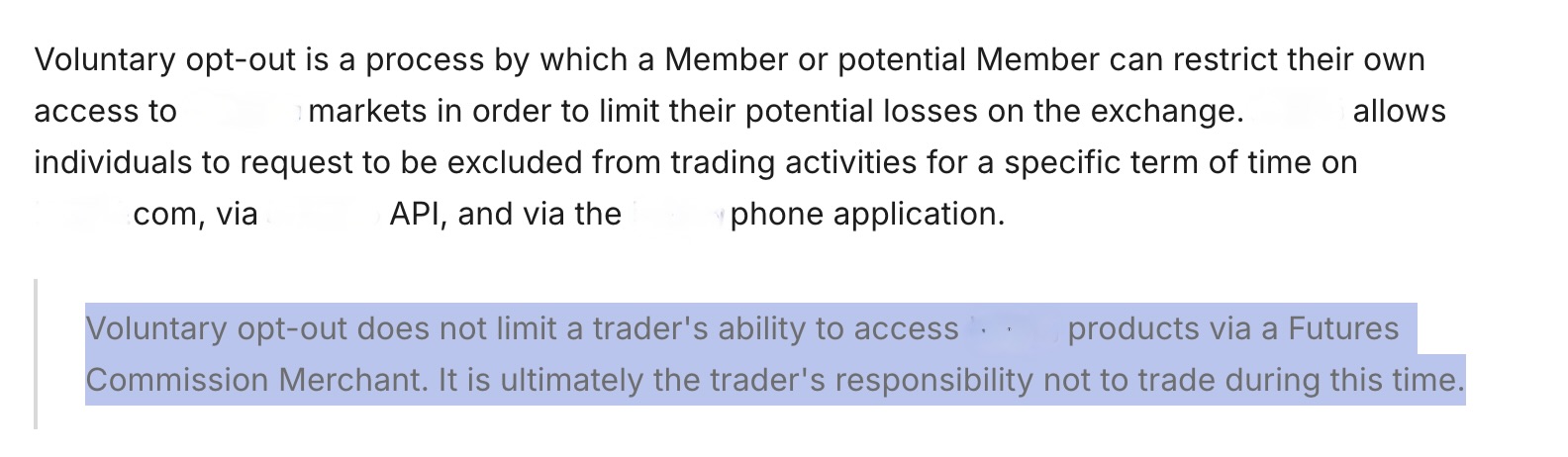
Further (at press) football prediction market trading providers do not have partnerships in place with leading mental health support providers to assist self-excluded members who may be in need of counseling.
Offshore Football Prediction Markets Invade U.S.
It didn’t take long after sports trading on prediction markets took off in the USA for illegal offshore gambling operators to take notice. As with traditional online sports betting, unregulated (by CFTC or otherwise) operators have already invaded the United States to accept money (including cryptocurrency) from U.S. players who use a VPN to access their platforms. Because they are licensed in regions such as Costa Rica, Curacao, and Malta, they remain at an arm’s length from federal law. The same dangers that exist with unregulated sports betting operators (view here) exist with unregulated football prediction market trading operators.
What Vulnerable Gamblers Need to Do
This new football gambling product isn’t going anywhere. It is something that vulnerable gamblers will have to learn to live with, and for problem gambling support providers to prepare for as national demand for treatment is all but certain to grow. For the time being, those predisposed to problematic gambling behavior and those who already exhibit tendencies are encouraged to connect or reconnect with a counselor right away so that they (yourself included) are better prepared to respond to the new wave of triggers that this new gambling offering will bring.
But even those who do not exhibit concerning behavior should be mindful. If interested in getting involved in football prediction market trading, pause until more robust Responsible-Gambling-esque (even if it’s not considered gambling, yet) protocols are in place. Wait until America’s trusted sports betting operators, those who do invest in player wellbeing, establish their own football trading products. At press, FanDuel has announced that it will offer event contracts with a third party provider, and DraftKings indicates that it is evaluating its own prediction market-adjacent option.
Concerned About Your Relationship with Football Prediction Market Trading?
CALL +1 (877) 426-4258
OR
Email help@kindbridge.com